
Software Supply Chain Security: What Changes When Trusted Code Enters Production
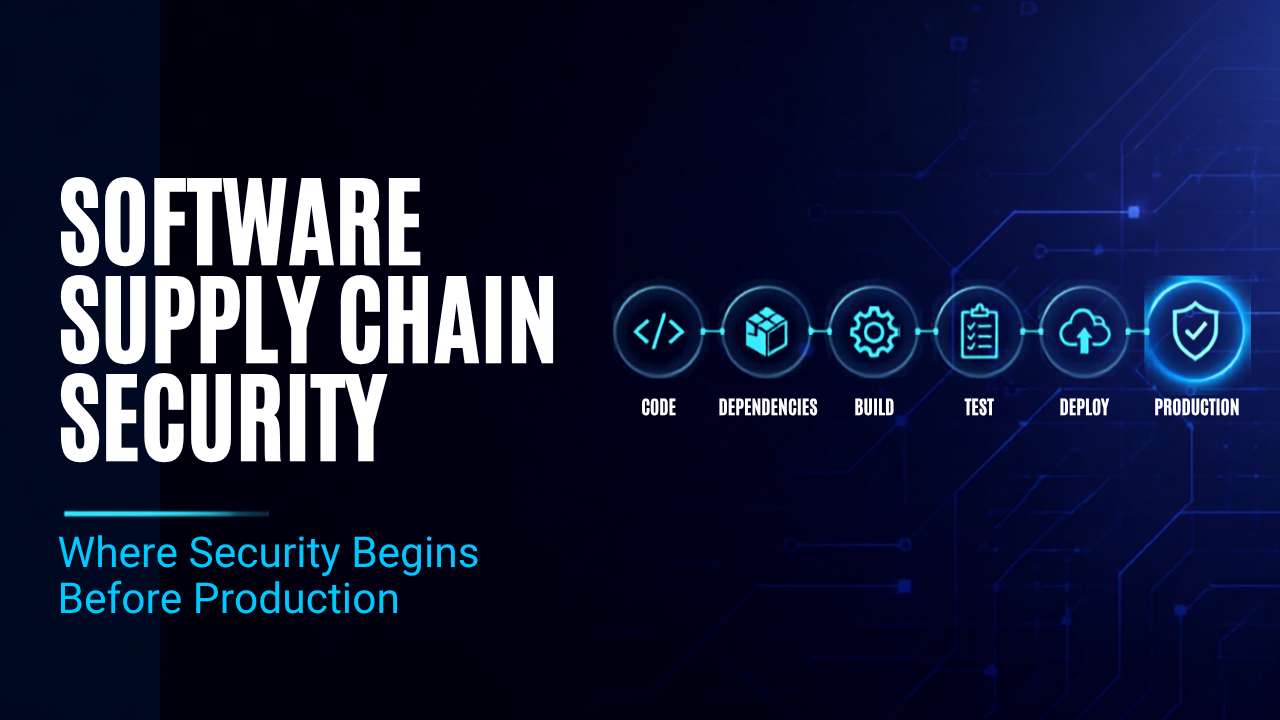
Modern software rarely moves from a developer's machine to production as a single, self-contained application.
It passes through repositories, dependencies, build systems, CI/CD pipelines, package managers, deployment tools, cloud environments, and increasingly AI coding assistants.
That creates a problem that traditional application security does not completely address.
The software can be trusted by the organization and still introduce risk.
This is where software supply chain security becomes important.
The question is no longer only whether the application itself is secure. Organizations also need to understand what enters the application, who or what changes it, how it moves through the development pipeline, and what eventually receives production access.
The Software Pipeline Is Part of the Security Boundary
A modern development pipeline can contain dozens of interconnected components.
A typical workflow may involve:
Source-code repositories
Open-source dependencies
Package registries
Build servers
CI/CD workflows
Container images
Infrastructure-as-code
Deployment platforms
Cloud services
Third-party integrations
AI coding assistants
Each component can introduce a dependency that the security team may not directly control.
This means the traditional idea of protecting the application perimeter is becoming less useful.
The pipeline itself has become part of the environment that needs protection.
Why Trusted Code Can Still Become a Problem
One of the difficult characteristics of supply-chain risk is that malicious activity does not always look malicious at first.
A compromised dependency may still appear legitimate.
A modified package may successfully pass through an automated build.
A compromised developer account may use legitimate credentials.
A CI/CD workflow may execute exactly as it was designed to execute.
The problem is that the trust relationship has already been established.
This is why software supply chain attacks can be particularly difficult to identify.
The attacker does not necessarily need to break through the final production environment.
They may instead find a trusted point earlier in the development process.
The Build Pipeline Deserves the Same Attention as Production
Security teams have traditionally concentrated heavily on production systems.
That makes sense. Production contains the applications and data that organizations are trying to protect.
But development infrastructure can have an equally important position in the chain.
Consider what a CI/CD pipeline may be able to access:
Source code
Secrets
Cloud credentials
Package repositories
Deployment environments
Container registries
Production systems
If an attacker gains control of a sufficiently privileged build process, the attacker may be able to influence what eventually reaches production.
That changes the security question from:
"Is our production application secure?"
to:
"Can we trust everything that was allowed to become part of our production application?"
That distinction is central to effective software supply chain security.
Dependencies Create Another Layer of Risk
Modern applications depend heavily on third-party and open-source software.
This provides enormous development advantages.
Teams do not need to build every component themselves. They can reuse established libraries, frameworks, packages, and tools.
But every dependency also creates another relationship that needs to be understood.
Organizations need visibility into questions such as:
Which dependencies are being used?
Where did they come from?
Which versions are deployed?
Who maintains them?
What happens when a dependency changes?
Which applications depend on a particular package?
Can a compromised package enter the build automatically?
Without that visibility, organizations may discover a problem only after the dependency has already reached multiple applications.
Security Has to Follow the Software
A major challenge is that software continuously changes.
A security review performed once at the beginning of a project cannot account for every dependency, code change, build, deployment, or configuration modification that happens afterward.
Security therefore needs to become part of the software lifecycle.
That means organizations should consider controls around:
Source
Protect repositories, developer identities, branches, and code changes.
Dependencies
Understand what third-party and open-source components are entering applications.
Build
Restrict who and what can modify or execute build processes.
Verification
Establish confidence that the artifact being deployed is the artifact that was intended.
Deployment
Control which identities and systems can move software into production.
Monitoring
Continue watching what happens after deployment rather than treating security as complete once the application is released.
This approach makes security part of the architecture rather than a final checkpoint.
Where Cybersecurity Services Fit
Technology alone does not automatically create a secure software lifecycle.
Organizations often have multiple tools covering source-code security, cloud security, identity, application security, DevOps, and monitoring.
The bigger challenge is connecting those controls into an operating model.
A cybersecurity service can help organizations assess those relationships across the environment, identify where trust is excessive, and establish controls around identities, applications, infrastructure, and development workflows.
The objective should not simply be to add another security product.
It should be to understand where software is trusted, why it is trusted, and what that trust allows it to do.
AI Is Adding Another Layer to the Software Lifecycle
AI coding assistants and AI development agents are increasingly becoming part of software development.
They can generate code, modify existing code, suggest dependencies, create tests, and accelerate development workflows.
That can improve productivity.
But it also means organizations need to understand how AI-generated changes enter existing development processes.
The important question is not whether AI-generated code is automatically unsafe.
It is whether the same verification, review, identity, dependency, and deployment controls apply regardless of how the code was produced.
If a development workflow automatically trusts changes because they came through an approved process, the origin of the change becomes less important than the controls surrounding that process.
What Organizations Should Review
A practical review of the software lifecycle should start with a few straightforward questions.
Who can change the code?
Who can modify dependencies?
Who can execute the build?
Which credentials can the pipeline access?
Can developers or automation bypass required reviews?
Can an unverified artifact reach production?
Can the organization trace what changed between development and deployment?
What happens when a trusted component becomes compromised?
These questions help expose gaps that may remain invisible when each security control is evaluated separately.
The Goal Is Not Zero Trust in Everything
Software supply chain security does not mean treating every developer, package, tool, or pipeline as malicious.
The practical goal is more precise:
Trust should be earned, limited, verified, and continuously evaluated.
A package should not receive unnecessary privileges simply because it is widely used.
A build system should not automatically receive unrestricted production access.
A developer identity should not have more permissions than the development workflow requires.
And a production deployment should not depend on an artifact whose origin cannot be established.
This creates a more defensible software lifecycle without preventing development teams from moving quickly.
Conclusion
The modern software environment is built on relationships.
Applications depend on packages.
Developers depend on tools.
Build systems depend on credentials.
Deployments depend on automation.
And production depends on everything that happened before deployment.
That is why software supply chain security is becoming an architectural concern rather than simply another security checklist item.
Organizations that understand these dependencies can reduce unnecessary trust, improve visibility across the development lifecycle, and make it harder for software supply chain attacks to move from a trusted component into production.
The strongest approach is not to wait until a trusted system fails.
It is to understand what is trusted, what it can access, and what it is allowed to change before it reaches production.
For organizations evaluating their broader cybersecurity service strategy, this is an important place to start: secure the software lifecycle, limit unnecessary access, and verify the path from code to production.